This blog brings together information about literary archives in the news, conferences and publications. Our book "The Boundaries of the Literary Archive: Reclamation and Representation" (Ashgate 2013) is out now!
13 Jul 2011
Lost folk tales come to light in the notebooks of Scottish tax collector
12 Jul 2011
Papers of Sci Fi Author Theodore Sturgeon bequeathed to The University of Kansas

‘The University of Kansas will be hoping Theodore Sturgeon's famous maxim that "90 per cent of everything is crap" does not apply to his own work after the papers of the legendary science fiction author were donated to its library.
The collection donated to the University of Kansas by his family is valued at $600,000 (£375,000), and includes the original manuscript of his most famous novel More Than Human, his notes for a Star Trek episode and his correspondence with fellow authors, from Isaac Asimov to Robert Heinlein and Harlan Ellison, in which Sturgeon shared story ideas and drafts with his contemporaries….’
Full text of article by Alison Flood from the Guardian website.
29 Jun 2011
Archiving Every Language Ever Spoken: The Rosetta Project

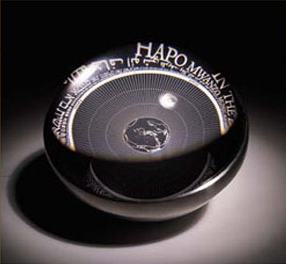
The Rosetta Project is a programme of The Long Now Foundation—a project which sets out to document every human language currently in use in the creation of a contemporary Rosetta Stone. The idea behind the archival venture is to create a publicly accessible digital library of human languages in collaboration with language specialists and native speakers.
The Rosetta list totals some 7,000 languages, all of which the project hopes to protect from disappearance without documentation through preservation on the Rosetta Disk. The Disk currently holds 13,000 microetched pages of word lists from 1,500 languages. The Rosetta website describes the project as The Long Now Foundation’s ‘ first exploration into very long-term archiving. It serves as a means to focus attention on the problem of digital obsolescence, and ways we might address that problem through creative archival storage methods.’
The three inch Disk features nearly 14,000 pages of microscopically etched information, able to be read by the human eye using optical magnification. The disk functions as a keystone for parallel archived information stored by the project as part of the Internet Archive.
The project organisers will be holding a ‘Record-a-thon’ on 30th of July in San Francisco, where video capture of live speakers in the Bay area will hope to archive evidence of more than a 100 languages through the telling of stories and conversations.
Recordings of spoken languages will be captured ideally in video, which, as director Laura Welcher explains, offers a ‘richer source of language information--it also documents context (to help with what the speaker is talking about, or pointing to), speech participants (like a conversation, or public speaking event), as well as the speaker's body and facial gestures.’
Interviewed by email for FastCompany.com, Welcher explained the intended use of this kind of archived data for researchers: ‘A corpus can be used in many different ways--a small corpus can provide language learning and teaching materials, as well as materials for the building of linguistic resources such as grammars and dictionaries (this is the kind of language documentation linguists are producing today). Then, with a larger corpus--say tens of hours of transcribed speech, we can start building acoustic models for speech recognition. With a few million words we can start to do machine translation. And these are the tools that enable a language to be used online--which I would argue is a crucial new domain for language use in the modern world.’
For a full transcription of the interview and article by Matthew Battles, click here.
20 Jun 2011
NATO Archives release declassified Cold War files
19 Jun 2011
Data Visualisation: blog as a word archive

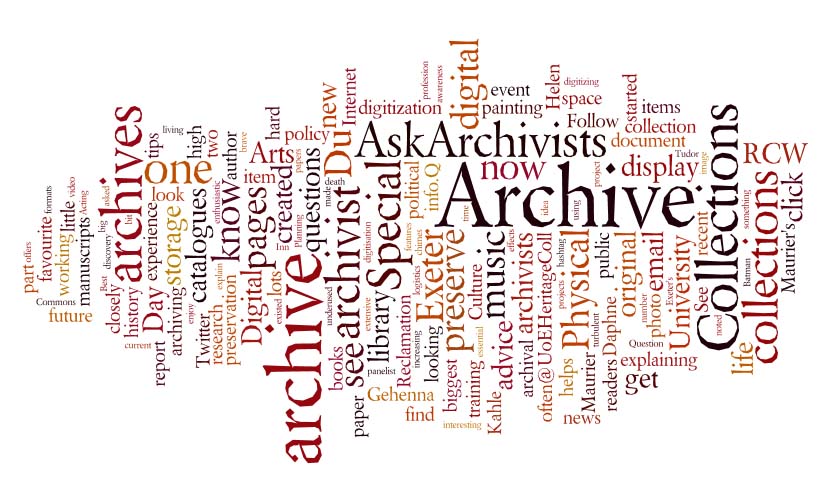
I am currently drafting an outline around digital archives (one can dream), and in the process of pondering the application of visualisation tools for archive and the digital humanities, I wondered what our little blog would look like on Wordle. Turns out we strongly favour the words 'special', 'one' and 'click' alongside the more obvious variations on 'archive'!
18 Jun 2011
Book Preservation: The New ‘Physical Archive’ of the Internet Archive
The founder of the Internet Archive—the non-profit organisation created in 1996 to build an internet library—recently announced the official launch of "the Physical Archive of the Internet Archive." The IA original dispersed the books it collected for digitization through donation, but is now shifting to storing and preserving them in state-of-the-art facilities, soliciting new donations in an effort to obtain “one copy of everything ever published”, with current storage at 450,000 items. 14 Jun 2011
Questions from #AskArchivists day!
The Bodleian
http://www.bodleian.ox.ac.uk/about/exhibitions/ask-archivists/askarchivists-q-and-a
Q: We're a music archive and we're curious: Which of all archives participating in #AskArchivists Day have music in their collections?
A: We do, although our music curator is unavailable today. See our music pages for a bit of basic info.
Q: To all #archives - What are your main reasons for #digitisation? #Genealogy? Preservation?
A: Lots - preservation and expanding access 2 big ones. See our digital collections pages for some examples.
Q: What's your favourite item in your archive?
A: The OU archivist says his favourite item is 1636 Uni statutes issued by Archbishop Laud.
Q: What's the most underused UK resource for research into everyday life in the Middle Ages?
A: Local land documents in county archives, for brave readers with high boredom thresholds?
Q: What's the biggest influence that your archive has had on public life?
A: We work hard to acquire, preserve & share archives of international value - from political to personal!
A: Our Conservative Party Archive helps promote democracy & encourage political accountability
Q: Is there a book or blog to explain how to use archives? E.g. when I don't know what box to order bec. I only know the topic.
A: Best way: look @ catalogue if available or email for advice - see our Special Collections catalogues & Special Collections 'Planning a Visit' for more info
Q: It's #AskArchivists day (involving our very own @bodleianlibs) - any tips from those in the field for aspiring archivists?
A: Get experience! Volunteering is great and helps you know if it's a career for you
A: From a modern papers archivist: Do research on job/institution. Be enthusiastic & positive!
A: From our CPA archivist: Read NRA email list for topical issues & to show awareness
Q: Are you doing any digitalisation of old books/diaries? If so, how extensive and how will it be accessible?
A: We do lots - see our digital collections pages and also most recent project Shelley-Godwin Archive
Q: What do you find is your biggest challenge as a modern-day archivist?
A: We have many, but one is what to do with digital formats (& analog!) Projects like @beamtweet are exploring!
Q: Entice me... I'm looking into privies of London, c10th-c15th (not literally looking into, of course). What might you have?
A: That's tough! Working on it - will update. For now, The Royal Palaces of Tudor England has info on high status royal privies
Alas no privy but prison, still enticing we hope: an image of The Clink, 1580, by Stephan Batman
Q: Is the Gehenna Press archive catalogued? We have some lovely Leonard Baskin/Ted Hughes items here at Exeter
A: We're working on Gehenna material, hoping to finish later this year. We do have a few images of the archive's arrival
(Question from our archive at Exeter! @UoEHeritageColl)
Q: Digital storage media suggestions for easier future migration?
A: Tough question. If you're sensible w storage and refresh often, files generally OK but ... Format is a bigger issue. Have a look at 'Sustainability of Digital Formats' from @librarycongress for some info.
Q: What are the Bod's plans for digitizing its catalogues of Western manuscripts?
A: We add new collection catalogues regularly (see Special Collections pages); others are goals but depend on time/funding
Q: Given space and logistics, I suppose you can't take on every archive you get offered. How do you decide which to preserve?
A: We have priorities/collection policy, but hard to say no to something good - often depends on how it fits with what we already have
Q: What is the best part of being an archivist?
A: Uncovering little bits of history no one knew (or remembered) existed!
The Smithsonian

http://blog.photography.si.edu/2011/06/13/summary-of-askarchivists-day-at-the-smithsonian/
We have lots of resources about how to get a job; types of archive and museum jobs history buffs would enjoy; and information about what archivists and photo archivists do.
A:Yes. Digital photo or scan for unlimited re-purposing and only 1 traumatic experience for the paper. (RCW)
8 Jun 2011
Exeter Arts Week: In the Archive with Daphne Du Maurier
As part of Exeter Arts Week, a special event is running at the University entitled 'In the Archive with Daphne Du Maurier.' This timely workshop chimes with the new discovery of her paintings, and offers an opportunity to see manuscripts of her most famous works including Rebecca and Jamaica Inn, led by Acting Head of Special Collections and Reclamation panelist Christine Faunch.The event takes place on Monday 13th June, 11am - 12:30pm, Seminar A/B Research Commons, University of Exeter.
Booking is essential and can be made my telephone or email. Please click on the link above for the Arts Weeks brochure for details.
7 Jun 2011
Du Maurier paintings to go on display
Paintings created by author Daphne Du Maurier are being put on public display for the first time, more than 20 years after her death. The artworks were created during a turbulent period in her life, and only now have her family allowed the collection to be seen.
BBC news have a video report on their website, which features interviews with Du Maurier's son and Exeter's Professor Helen Taylor (one of our two Reclamation keynotes from back in October).Helen remarks on Du Maurier's painting as an escape from writer's block, explaining that the author 'went into her little hut in the grounds of Menabilly where she was living, and instead of writing, which is what everyone thought she was doing, she was painting.'
6 Jun 2011
Lost Conan Doyle novel to be published
"After languishing unpublished for almost 130 years, Sir Arthur Conan Doyle's first novel is set to be released for the first time this autumn. [...]
http://www.guardian.co.uk/books/2011/jun/06/lost-conan-doyle-novel-narrative-john-smith?CMP=twt_gu
"As you might expect with the creator of Sherlock Holmes, there's a bit of a mystery around the manuscript," said Rachel Foss, lead curator of modern literary manuscripts at the British Library, which is publishing the 150-page book in November. "He wrote it in 1883 and 1884, when he was starting to try to establish himself in the medical profession and as a writer. He sent it to a publisher, but it got lost in the post, so he decided to try and redo it from memory. The manuscript we have is the novel as reconstructed from memory, and it stops around chapter six."