20 Jul 2011

How to archive tweets

As archives encounter more and more 'Born Digital' material, questions surrounding the storing of such material become increasingly important. Here are two articles on how to personally archive 'tweets' from twitter which currently only keeps a searchable archive of the last 3200 tweets at a time for each account and as these roll over, tweets are lost.

One article speculates on the uses of archiving tweets: "Not everyone will care to archive their tweets, but it can be a good idea if you want to keep a record of what you’ve said on Twitter. You might be running a business Twitter account and want to save your interactions with customers, or you might be using Twitter to write 140-character haikus that you eventually compile into a book."
How to archive your tweets -  http://www.mediabistro.com/alltwitter/how-to-archive-your-tweets_b4707

Another article - http://news.idg.no/cw/art.cfm?id=9C7F0E3F-1A64-6A71-CE891C8591844C5A

19 Jul 2011

Online Watermark Archive

The Gravell Watermark Archive brings together over 50,000 watermarks from across America and Europe. The collection incorporates some 7,500 images collected by American-watermark expert Thomas L. Gravell, and Charles-Moise Briquet’s documentation of around 45,000 unpublished marks.

The online archive allows users to search a range of designs from mythical creatures to symbolic objects, intricately rendered by a process of attaching wire to a paper mould. Watermarks function to identify paper products related to particular makers or mills at specific times and places, and their inclusion in the online database can assist researchers to dating elusive manuscripts.

Click here for a full article on the archive by Erica Olson, and here for a link to the Gravell website.

15 Jul 2011

Saving manuscripts 'for the nation' the meaning and 'value' of the Jane Austen Manuscript

Interesting piece below, which stresses the idea of saving the manuscript 'For the Nation' which has been a dominant idea in this field for some time now. But how important is this when the rest of her manuscripts are "scattered around the world in libraries and private collections." and all of her papers are brilliantly collected online (http://www.janeausten.ac.uk)? Especially with the work that has gone into the online versions where "Each manuscript can be opened in a variety of ways: as facsimile pages which can be magnified using ‘zoomify’; as transcribed text set side by side with the original manuscript page; or through a Headnote that provides details of the manuscript’s history and physical description. ". 
So this recent sale which cost "in excess of 1 million pounds" reopens questions such as what is the value of examining the original vs the excellent online version? Who will have access? And what does the acquisition mean for scholarship? etc.


                                                            *

Article by the Bodleian below:


"The Bodleian Libraries have acquired at auction the autograph draft manuscript of Jane Austen’s unfinished novel The Watsons. The last major Austen manuscript to have been in private hands, The Watsons is the most significant Austen item to have come to the market in over twenty years. 

The acquisition which cost in excess of £1 million was made possible with a substantial grant (£894,700) from the National Heritage Memorial Fund (NHMF). Other generous funders are the Friends of the National Libraries, the Friends of the Bodleian, Jane Austen's House Museum (Jane Austen Memorial Trust) as well as other supporters. 
Richard Ovenden, Deputy Librarian, Bodleian Libraries said: ‘The Bodleian Libraries are delighted to have succeeded in their bid to save Jane Austen’s draft manuscript of the The Watsons for the nation.  The manuscript is such a valuable part of our literary heritage and we are glad it will stay now in Britain. We will make the manuscript available to the general public who can come and see it as early as this autumn when The Watsons will indeed be a star item in our forthcoming exhibition Treasures of the Bodleian. Our thanks go to all our supporters for their enormous generosity in supporting this purchase and in recognising the importance of keeping this priceless manuscript in a British institution.’
Carole Souter, Chief Executive of the NHMF, said:  ‘This was an unprecedented opportunity to acquire the earliest surviving original draft of a novel by one of our greatest and most popular writers. It is fitting that NHMF, the fund of last resort for our national heritage, could step in – in the face of intense, worldwide competition - to help keep this exceptional work for display and scholarship in the UK.’

The Watsons is Jane Austen’s first extant draft of a novel in process of development and one of the earliest examples of an English novel to survive in its formative state. Only seven manuscripts of fiction by Austen are known to survive. The Watsons manuscript is extensively revised and corrected throughout, with crossings out and interlinear additions. It is a testimony of Jane Austen’s efforts to give shape to the earliest ideas as they pour onto paper, as she reviews, revises, deletes and underscores. The Watsons is the very genesis of fiction from one of the Britain’s greatest and best-loved writers. 

The Bodleian Library already holds her Volume the First, a manuscript of Austen’s juvenilia. The University of Oxford leads research in Jane Austen and it has recently launched a digital resource The Jane Austen’s Fiction Manuscripts Digital Edition (www.janeausten.ac.uk) which reunites in a virtual space all Jane Austen’s handwritten manuscripts for the first time since 1845 when her sister Cassandra dispersed the collection.  "

13 Jul 2011

Lost folk tales come to light in the notebooks of Scottish tax collector


"Lost tales of a Hebridean Atlantis, magical water horses, and Robert Burns’ murderous ancestors have been uncovered in a major study of Scotland’s foremost Victorian folklorist that has been funded by the Arts and Humanities Research Council (AHRC).
For the first time the notebooks of Alexander Carmichael, a man compared to Germany’s Brothers Grimm, have been transcribed, catalogued, indexed and imaged. They have been made available online by the University of Edinburgh’s Special Collections.
The publication is the third part of the Carmichael Watson Project, a decade-long project to unlock one of the world's major folklore resources.
Working as a tax collector on Lewis, Argyll, Uist and the West Highlands from 1860, Carmichael spent 50 years collecting legends, songs, curses, charms, prayers, and oral history from Gaelic-speakers. In total Carmichael spoke to more than 400 individuals, filling 28 notebooks full of tales. He recorded the names, ages, occupations and locations of almost everyone he met.
Carmichael used his notes for his masterwork, Carmina Gadelica. Published in 1900 it was a seminal work within the Celtic Twilight movement of the time. Yet it is estimated that only a tenth of the work collected made it into the book.
The AHRC award has allowed researchers and archivists to spend two years deciphering and transcribing Carmichael’s notoriously bad handwriting. They have uncovered hundreds of unpublished stories including tales of the Green Island, the Hebridean version of the Atlantis myth, the giant Finn McCool, and magical water horses. 
One historical account records a new date for the last sighting of the Great Auk, a now extinct, oversized bird that resembled a penguin. Reputedly last seen in Iceland in 1844, Carmichael records the sighting of one in St Kilda four years later. It met its demise when islanders believed it was possessed by a demon and beat it to death.
Dr Donald William Stewart, senior researcher for the Carmichael Watson Project, said: “For over fifty years, Alexander Carmichael tirelessly, even obsessively, recorded the culture, lore, and beliefs of his native Scottish Highlands. By the end of his life in 1912, he was both Celtic guru and folklore jukebox, the internationally-recognised authority on Scottish Gaelic songs, stories, traditions, and beliefs. Carmichael’s voluminous papers, now preserved in Edinburgh University Library, form one of the foremost folklore collections in the world.”
Users of the new resource will also be able to search the catalogue for names of individuals who shared stories, or were mentioned in tales. For example, individuals who trace their family tree to Uist can search for mentions of their ancestors within Carmichael’s notebooks.
The website (www.carmichaelwatson.lib.ed.ac.uk) was launched in conjunction with a two-day conference 'Alexander Carmichael: Collecting, Controversy and Contexts' and an exhibition, ‘Unlocking the Celtic Collector’, is running in the University Library until 22 July."

12 Jul 2011

Papers of Sci Fi Author Theodore Sturgeon bequeathed to The University of Kansas


‘The University of Kansas will be hoping Theodore Sturgeon's famous maxim that "90 per cent of everything is crap" does not apply to his own work after the papers of the legendary science fiction author were donated to its library.

The collection donated to the University of Kansas by his family is valued at $600,000 (£375,000), and includes the original manuscript of his most famous novel More Than Human, his notes for a Star Trek episode and his correspondence with fellow authors, from Isaac Asimov to Robert Heinlein and Harlan Ellison, in which Sturgeon shared story ideas and drafts with his contemporaries….’

Full text of article by Alison Flood from the Guardian website.

29 Jun 2011

Archiving Every Language Ever Spoken: The Rosetta Project


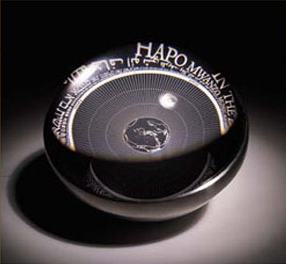
The Rosetta Project is a programme of The Long Now Foundation—a project which sets out to document every human language currently in use in the creation of a contemporary Rosetta Stone. The idea behind the archival venture is to create a publicly accessible digital library of human languages in collaboration with language specialists and native speakers.

The Rosetta list totals some 7,000 languages, all of which the project hopes to protect from disappearance without documentation through preservation on the Rosetta Disk. The Disk currently holds 13,000 microetched pages of word lists from 1,500 languages. The Rosetta website describes the project as The Long Now Foundation’s ‘ first exploration into very long-term archiving. It serves as a means to focus attention on the problem of digital obsolescence, and ways we might address that problem through creative archival storage methods.’

The three inch Disk features nearly 14,000 pages of microscopically etched information, able to be read by the human eye using optical magnification. The disk functions as a keystone for parallel archived information stored by the project as part of the Internet Archive.

The project organisers will be holding a ‘Record-a-thon’ on 30th of July in San Francisco, where video capture of live speakers in the Bay area will hope to archive evidence of more than a 100 languages through the telling of stories and conversations.

Recordings of spoken languages will be captured ideally in video, which, as director Laura Welcher explains, offers a ‘richer source of language information--it also documents context (to help with what the speaker is talking about, or pointing to), speech participants (like a conversation, or public speaking event), as well as the speaker's body and facial gestures.’

Interviewed by email for FastCompany.com, Welcher explained the intended use of this kind of archived data for researchers: ‘A corpus can be used in many different ways--a small corpus can provide language learning and teaching materials, as well as materials for the building of linguistic resources such as grammars and dictionaries (this is the kind of language documentation linguists are producing today). Then, with a larger corpus--say tens of hours of transcribed speech, we can start building acoustic models for speech recognition. With a few million words we can start to do machine translation. And these are the tools that enable a language to be used online--which I would argue is a crucial new domain for language use in the modern world.’

For a full transcription of the interview and article by Matthew Battles, click here.

20 Jun 2011

NATO Archives release declassified Cold War files

"The NATO Archives is proud to announce the public disclosure of the documents on the NATO planning for a Berlin emergency during the Cold War. The files, consisting of close to four hundred declassified Council documents and correspondence spanning the years 1961 to 1968, present a treasure trove of information for researchers, librarians, students and anyone with an interest in the political and military history of this era.

The release of these documents on the NATO Archives website marks the first time that declassified and publicly disclosed NATO files will be presented on the Internet for consultation and download. (www.nato.int/archives/berlin)

The public disclosure of these NATO documents also coincides with the 50th anniversary of the construction of the Berlin Wall. It was only towards the end of 1961 that the Alliance decided to play a more active role. The North Atlantic Council tasked the NATO Military Authorities to draft a series of top secret contingency plans to prepare for the possibility of a Berlin Emergency. SACEUR’s Berlin Contingency (BERCON) Plans involved ground and air actions along the access routes and air corridors to Berlin, and also included the possible demonstrative use of nuclear weapons. SACLANT’s Maritime Contingency (MARCON) Plans proposed putting pressure on the Soviet bloc though worldwide maritime measures.


To celebrate this release, the NATO Archives has organized a series of events to commemorate this pivotal moment of the Cold War: a screening of the 1962 NATO-produced film ‘Background to Berlin’, a seminar featuring presentations by noted historians, a commemorative booklet, and in cooperation with the German Delegation at NATO, a multimedia exhibition focusing on the Berlin Crisis, the Wall and the Allied Response. The exhibition opens on 22 June 2011, with the official opening ceremony taking place on 23 June 2011 at 13h.

For online access to these documents on Berlin, as well as other forthcoming documents please visit the NATO Archives website at: www.nato.int/archives.

 
For complete access to the thousands of other declassified documents that have been publicly disclosed, researchers and others interested in the history of the Organization are welcome to visit the NATO Archives Reading Room at NATO HQ in Brussels."

19 Jun 2011

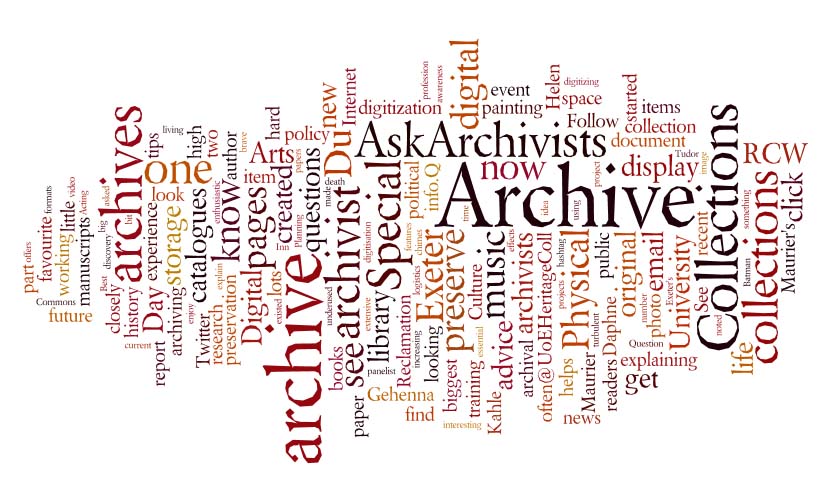
Data Visualisation: blog as a word archive


I am currently drafting an outline around digital archives (one can dream), and in the process of pondering the application of visualisation tools for archive and the digital humanities, I wondered what our little blog would look like on Wordle. Turns out we strongly favour the words 'special', 'one' and 'click' alongside the more obvious variations on 'archive'!

18 Jun 2011

Book Preservation: The New ‘Physical Archive’ of the Internet Archive

The founder of the Internet Archive—the non-profit organisation created in 1996 to build an internet library—recently announced the official launch of "the Physical Archive of the Internet Archive." The IA original dispersed the books it collected for digitization through donation, but is now shifting to storing and preserving them in state-of-the-art facilities, soliciting new donations in an effort to obtain “one copy of everything ever published”, with current storage at 450,000 items.
This Physical Archive reflects some of the effects of digitization projects in its response to the increasing number of library books moved to repositories to make space for meeting and working spaces, and the throwing out of original library texts in the wake of digitized Google versions. Founder Brewster Kahle explains that the Physical Archive seeks to preserve original copies for future researchers and readers, underscoring the importance of maintaining physical archiving in a digital era.
For a report from Libraryjournal.com, click here; for an article by Kahle explaining the impetus behind the Physical Archive in full, click here.

14 Jun 2011

Questions from #AskArchivists day!

A couple of places have noted the questions they were asked and it makes interesting reading! Here are two examples. In other news the University of Exeter Heritage Collections and Culture Services which includes Special Collections, the Bill Douglas Centre and Arts & Culture are now on twitter! Follow them @UoEHeritageColl

The Bodleian
 http://www.bodleian.ox.ac.uk/about/exhibitions/ask-archivists/askarchivists-q-and-a

We have compiled our Twitter answers to #AskArchivists Day questions here; you can find further #AskArchivists Day questions and responses by searching Twitter for the hashtag #AskArchivists.

Q: We're a music archive and we're curious: Which of all archives participating in #AskArchivists Day have music in their collections?
A: We do, although our music curator is unavailable today. See our music pages for a bit of basic info.

Q: To all #archives - What are your main reasons for #digitisation? #Genealogy? Preservation?
A: Lots - preservation and expanding access 2 big ones. See our digital collections pages for some examples.

Q: What's your favourite item in your archive?
A: The OU archivist says his favourite item is 1636 Uni statutes issued by Archbishop Laud.

Q: What's the most underused UK resource for research into everyday life in the Middle Ages?
A: Local land documents in county archives, for brave readers with high boredom thresholds?

Q: What's the biggest influence that your archive has had on public life?
A: We work hard to acquire, preserve & share archives of international value - from political to personal!
A: Our Conservative Party Archive helps promote democracy & encourage political accountability

Q: Is there a book or blog to explain how to use archives? E.g. when I don't know what box to order bec. I only know the topic.
A: Best way: look @ catalogue if available or email for advice - see our Special Collections catalogues & Special Collections 'Planning a Visit' for more info

Q: It's #AskArchivists day (involving our very own @bodleianlibs) - any tips from those in the field for aspiring archivists?
A: Get experience! Volunteering is great and helps you know if it's a career for you
A: From a modern papers archivist: Do research on job/institution. Be enthusiastic & positive!
A: From our CPA archivist: Read NRA email list for topical issues & to show awareness

Q: Are you doing any digitalisation of old books/diaries? If so, how extensive and how will it be accessible?
A: We do lots - see our digital collections pages and also most recent project Shelley-Godwin Archive

Q: What do you find is your biggest challenge as a modern-day archivist?
A: We have many, but one is what to do with digital formats (& analog!) Projects like @beamtweet are exploring!

Q: Entice me... I'm looking into privies of London, c10th-c15th (not literally looking into, of course). What might you have?
A: That's tough! Working on it - will update. For now, The Royal Palaces of Tudor England has info on high status royal privies
Alas no privy but prison, still enticing we hope: an image of The Clink, 1580, by Stephan Batman

Q: Is the Gehenna Press archive catalogued? We have some lovely Leonard Baskin/Ted Hughes items here at Exeter
A: We're working on Gehenna material, hoping to finish later this year. We do have a few images of the archive's arrival
(Question from our archive at Exeter! @UoEHeritageColl)

Q: Digital storage media suggestions for easier future migration?
A: Tough question. If you're sensible w storage and refresh often, files generally OK but ... Format is a bigger issue. Have a look at 'Sustainability of Digital Formats' from @librarycongress for some info.

Q: What are the Bod's plans for digitizing its catalogues of Western manuscripts?
A: We add new collection catalogues regularly (see Special Collections pages); others are goals but depend on time/funding

Q: Given space and logistics, I suppose you can't take on every archive you get offered. How do you decide which to preserve?
A: We have priorities/collection policy, but hard to say no to something good - often depends on how it fits with what we already have

Q: What is the best part of being an archivist?
A: Uncovering little bits of history no one knew (or remembered) existed!


The Smithsonian

http://blog.photography.si.edu/2011/06/13/summary-of-askarchivists-day-at-the-smithsonian/
The tweets started coming in fast and furious early that morning. Many wanted to know more about the archival profession and the education and training needed to be an archivist.
We have lots of resources about how to get a job; types of archive and museum jobs history buffs would enjoy; and information about what archivists and photo archivists do.
 
Q: do you have any advice for recent grads who want to pursue archiving?
A: http://ow.ly/5dSRf & http://ow.ly/5dSRg should get you started. Follow up ?s welcome anytime. Thanks! (RCW)

Q: Do uHav #DigitalArchivists &do they wk closely w/ IT or archives workers? Any idea of bg & training?
A: LSF: I am one, & we wrk closely w/SI IT. More than basics of computers, systems, sftwre. Coding sklls a+.

Q:Any advice or tips on curating exhibits w/ archive materials-how to display, preserve, document?
A: Respect archival context. Across the pond has an exhaustive document for display: http://ow.ly/5e9sw (RCW)

Q: What do you suggest for collections that require a confidentiality/privacy arrangement with the researcher?
A: LSF: Here's our policy for restricted collections: http://ow.ly/5eead
 
Q: is photocopying worse for preservation of paper docs than photographing them using a flash?
A:Yes. Digital photo or scan for unlimited re-purposing and only 1 traumatic experience for the paper. (RCW)