26 Dec 2011

Re-viewing Austen through an Unseen Portrait

Tonight, BBC2 is airing ‘Jane Austen: The Unseen Portrait’.
Martha Kearny follows Dr Paula Byrne, who believes she has come across a portrait of Jane Austen lost to the world for nearly two centuries, engaging with a range of literary scholars alongside art history experts and discussing
our idea of Austen, our desire to know more about her appearance and how this impacts upon her reputation and continued fascination with the author.
As Austen is a writer about whom surprisingly little is known, these kinds of new finds are rather intriguing—as much for the journey they inspire in delving through different kinds of materials in the archiving of literary figures, as for the uphill struggle in establishing (and potentially eventually disregarding) the authenticity of any new additions to a literary history.
I’m watching it now, but it will surely be up on IPlayer asap! The BBC page can be found here: http://www.bbc.co.uk/programmes/b018nz2x

8 Dec 2011

Dickens manuscript illuminates author's workings


"Dense with ink, a spider web of crossings-out, rewritings and even text-speak, the manuscript of Charles Dickens's much-loved novel Great Expectations – which has been published in facsimile for the first time – offers a unique insight into the mind of the great novelist.

Dickens bound and gave his manuscript of Great Expectations to his friend Chauncy Hare Townshend, who bequeathed it to the Wisbech and Fenland Museum in 1868. Fragile and in its original binding, the 1861 manuscript has been at the museum ever since, available to view on the first Saturday of every month but otherwise kept in a safe. Now the museum has worked with Cambridge University Press to scan and reproduce the manuscript in book format for the first time.

It shows Dickens's terrible handwriting, how his lines sloped down to the right and how he would squeeze a few extra words into the space this left at the bottom of a page, and his notes on the times of the tides, crucial to Magwitch's capture at the end of the book.

[...] the last page of the manuscript reveals part of Dickens's original ending to the novel, in four lines crossed out by the author. Dickens was told to change his sad ending, in which Pip and Estella part forever, by his friend and fellow novelist Edward Bulwer-Lytton.

"You can see the beginnings of the original ending," said Wright. "He's boxed it and crossed through it with vertical lines, confirming that a different version of the ending was written. What we don't know, however, is what happened to the remainder of the manuscript with that different ending."

The manuscript also shows the final sentence of the novel to have been, originally, "I saw the shadow of no parting from her but one". When the story was published in 1861 in the periodical All The Year Round, the two final words had been cut."

Alison Flood

For the full story see - http://www.guardian.co.uk/books/2011/dec/08/dickens-manuscript-great-expectations?CMP=twt_fd

1 Dec 2011

Lost Jack Kerouac Novels Unearthed from the Author's Personal Archive

Beat poet and author Jack Kerouac’s first novel, entitled The Sea is My Brother, has up till now never been seen in print. Thanks to his brother-in-law, however, it now finally makes it to publication thisweek some 40 years since Kerouac’s death after a discovery in the author’s personal archive.
Up till now sparse knowledge of the novel’s existence had been traced through brief references in Kerouac’s letters, but the size and scope of the volume proved unexpected. The book, written when Kerouac was 20, is based on his experiences as a merchant seaman and and features correspondence between the author and his close friend Sebastian Sampas.
The book’s editor, Dawn Ward, commented on the significance of the find, explaining that the publication of this lost work "is really quite important as it shows how Jack developed his writing process... [he] opens up and shows a side to him that we don't normally see in his books."

17 Nov 2011

Digital Humanities Resource Guide

This website curates a list of digital humanties initiatives with links to the projects. Generally interesting, but particularly so for the list titled "The Archive, Digital Preservation of Analog & Born-Digital Materials", which I have reproduced here:


  • Transcribe Bentham, based at University College London, has been crowdsourcing the transcription of thousands of manuscripts written by Jeremy Bentham (1748-1832). Anyone can sign up to participate, viewing the original documents, and transcribing and encoding them online in a wiki; instructions and a discussion forum are provided.


  • NEW! See also What's On the Menu?, which invites users to transcribe the New York Public Library's collection of 40,000 menus; a project of NYPL Labs.


  • The Rossetti Archive, sponsored by the Institute for Advanced Technology in the Humanities, University of Virginia under the direction of Jerome McGann, provides access to Dante Gabriel Rossetti's complete works, including high-quality images, detailed descriptions and commentary. Related works (contemporary and antecedents) are also included, along with a bibliography.


  • The Walt Whitman Archive – "an electronic research and teaching tool that sets out to make Whitman's vast work easily and conveniently accessible to scholars, students, and general readers, drawing on the resources of libraries and collections from around the United States and around the world." Directed by Kenneth M. Price (University of Nebraska-Lincoln) and Ed Folsom (University of Iowa).


  • Preserving Virtual Worlds – exploring methods for preserving digital games, electronic literature, and environments such as Second Life. A collaboration between Maryland Institute for Technology in the Humanities (MITH), the University of Illinois at Urbana-Champaign, Stanford University, the Rochester Institute of Technology, and Linden Lab (creators of Second Life).


  • The work of institutions such as the Ransom Center at the University of Texas in preserving born-digital textual materials.


  • Omeka – a free, open source web-publishing platform for the display of library, museum, archives, and scholarly collections and exhibitions; developed by the team at Roy Rosenzweig Center for History and New Media (CHNM) at George Mason University "with non-IT specialists in mind, allowing users to focus on content and interpretation rather than programming."
  • 16 Nov 2011

    How May Digital Collections Serve Scholarly Needs?


    "As part of the Collections Interoperability working group, we are investigating the question of scholars’ needs with digital collections: What kind of functionalities, features, and/or services do humanities scholars need in digital collections, in order for the collections to be useful in research?

    The reason we ask is twofold: First, we’d like to know what types of digital collections should be prepared and incorporated into the Bamboo research platform. While there are a few all-encompassing general digital collections, such as the Hathi Trust Digital Library, there are many more digital collections with limited content or specialized focuses, and it is hard to determine how to select collections for incorporation into Bamboo.
    Secondly, a larger question faces libraries and digital libraries about effective collection development strategies for digital collections: How can we build digital libraries that aren’t simply mass collections of materials or are based on libraries’ classifications, but that directly address scholars’ research needs?

    To explore this question, we decided to launch a study that would create a needs assessment for scholars and digital collections. Over the summer, I worked with Indiana University librarian Angela Courtney to contact humanities librarians, digital humanities coordinators, and academic technologists at the twelve member institutions of the CIC academic consortium and participating Bamboo partner institutions. We ultimately convinced nine librarians and staffers to work with us on conducting a survey and interviews with their humanities faculty. The participating institutions are the University of Illinois at Urbana-Champaign, Indiana University, Northwestern University, University of Illinois at Chicago, University of Nebraska–Lincoln, Michigan State University, University of Iowa, University of Chicago, University of Minnesota, Penn State University, and the University of Maryland.

    After months of IRB wrangling, writing the test instruments, pre-testing, and consultations, we launched the study in late October. A survey has been distributed to randomly selected faculty members in all of the English and history departments at the aforementioned institutions, and will run through December. Interviews will be conducted in November and December with select faculty members from fine arts and performing arts departments on the campuses who are involved in digital scholarship. Follow-up interviews will also be conducted with survey respondents who indicated a willingness to be interviewed.

    We anticipate that this study will enable us to gain new insights into the transformations occurring in humanities research with the advent of digitized materials. An update will be forthcoming as results are analyzed this winter, and we’re excited for what the data will tell us!"
    By Harriett Green

    11 Nov 2011

    Unpublished Siegfried Sassoon Poems Found

    Dr Jean Moorcroft Wilson, Siegfried Sassoon‘s biographer, unearthed some unpublished poems at Cambridge University. Follow this link to BBC for a listen!


    What she find most noticeable about the poems she discovered is that they aren't the angry war poems one might expect from Sassoon, but rather glorify war at points. 
    Professor Sheffield argues against the dominant view that First World War poets presented of the war and Dr Moorcroft Wilson argues in counter to this.

    8 Nov 2011

    Forthcoming Arnold Dreyblatt Lecture: From the Archives: Installation and Performace 1990-2011

    To mark the launch of the new Visual Culture programme at the University of Exeter, the first of five visiting speaker events throughout 2011/12 will be held on Wednesday November 23rd, 2.00-4.00pm. This event will take place on the University’s Streatham Campus, in the Queens Building, LT4.


    The event will feature a talk by the artist Arnold Dreyblatt, entitled ‘From the Archives: Installation and Performance 1990-2011’.

    Arnold Dreyblatt (b. New York City, 1953) is an American media artist and composer. He has been based in Berlin, Germany since 1984. In 2007, Dreyblatt was elected to lifetime membership in the German Academy of Art (Akademie der Künste, Berlin). He is Professor for Media Art at the Muthesius Academy of Art and Design in Kiel, Germany.
    Dreyblatt's visual work creates complex textual and spatial visualizations for memory. His works, which reflect on such themes as recollection and the archive, include permanent works, digital room projections, dynamic textual objects and muti-layered lenticular text panels. His work been exhibited and staged in galleries, museums and public spaces such as the Hamburger Bahnhof Museum for Contemporary Art, Berlin; The Jewish Museum in New York; the Museum für Angewandte Kunst, Vienna and the Akademie der Künste, Berlin. Permanent public art works are on display at the HL Holocaust Center in Oslo and the Jewish Museum in Berlin. He has received numerous commissions and awards including the Foundation for Contemporary Performance Arts and the Förderpreis der Akademie der Künste.

    Dreyblatt will be speaking about his work from 1990 – 2011. He will take the audience through his processes and include still and moving image documentation.


    The talk is free, but booking is essential, and can be made here: http://www.arnolddreyblattlecture.eventbrite.com/

    6 Nov 2011

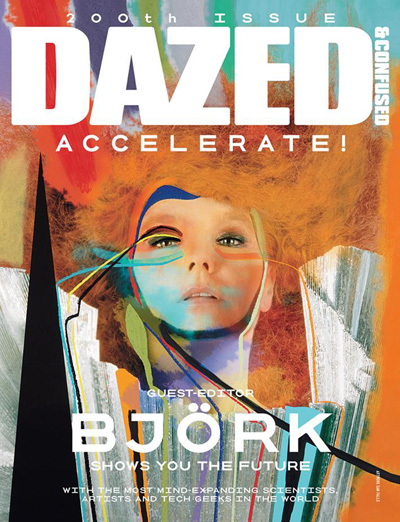
    What would Dazed and Confused have done differently? - They'd archive

    http://www.guardian.co.uk/media/2011/nov/05/dazed-confused-gang-still-cool

    Reading the above article I noticed this paragraph:

    "If they could have done anything differently, I ask, what would they change? "We'd archive," says Hack, immediately. "There were these Jake and Dinos Chapman sculptures that they made for one of our events. They all got trashed, of course. No one knew to give a shit. And when Radiohead debuted OK Computer for us nobody thought to record it – there were no smartphones then, nobody took cameras into clubs. Everything felt very … temporary.""


    27 Oct 2011

    The Black Hours - Online Exhibition of a rare black manuscript

    An extraordinary online exhibition of a Book of Hours named The Black Hours, was given this name becase the manuscripts are written and illuminated on vellum that is stained or painted black. The anonymous painter of the Black Hours is an artist whose style depended mainly upon that of Willem Vrelant, one of the dominant illuminators working in Bruges from the late 1450s until his death in 1481. The website describes it as follows:

    "The text is written in silver and gold, with gilt initials and line endings composed of chartreuse panels enlivened with yellow filigree. Gold foliage on a monochromatic blue background makes up the borders. The miniatures are executed in a restricted palette of blue, old rose, and light flesh tones, with dashes of green, gray, and white. The solid black background is utilized to great advantage, especially by means of gold highlighting."
    Unfortunately the very thing which makes the manuscript so unusual is difficult to preserve:

    "The black of its vellum—the very thing that makes the codex so striking—is also the cause of some serious flaking. The carbon used in the black renders the surface of the vellum smooth and shiny—a handsome but less than ideal supporting surface for some of the pigments. The Morgan's Black Hours is awaiting conservation treatment. In the meantime, we are pleased to offer a virtual facsimile."

    Manucript - http://www.themorgan.org/collections/works/BlackHours/manuscript.asp

    20 Oct 2011

    Archiving a 100 year history of fan magazines

    This October is the 100th anniversary of the film fan magazine!


    The publication of the very first issue of ‘The Pictures’ marked the birth of a rich 100 year history of film magazines, and Exeter's Bill Douglas Centre archive holds a copy of this first edition, amidst a wealth of other fan papers spanning the history of cinema.


    To commemorate, a short piece offering a brief history of the British fan magazine and my research with these objects in the archive is now up on the University of Exeter homepage news and events section, and also in the Western Morning News.