20 Oct 2011

Archiving a 100 year history of fan magazines

This October is the 100th anniversary of the film fan magazine!


The publication of the very first issue of ‘The Pictures’ marked the birth of a rich 100 year history of film magazines, and Exeter's Bill Douglas Centre archive holds a copy of this first edition, amidst a wealth of other fan papers spanning the history of cinema.


To commemorate, a short piece offering a brief history of the British fan magazine and my research with these objects in the archive is now up on the University of Exeter homepage news and events section, and also in the Western Morning News.

11 Oct 2011

#libcampuk: special collections

Just a quick post to direct you to an interesting discussion on the role of special collections and how to promote/expand them. Topics covered: issues surrounding outreach, the merits of physical or online exhibitions, hidden special collections etc.


The blog post is a summary of the issues discusses at 'Library Camp UK'.


Here is - the blog post


http://www.librarycamp.co.uk/

3 Oct 2011

"early drafts were locked away for a reason"?

An article in the Telegraph titled "It's exciting to find  manuscripts abandoned by writers or musicians but early drafts were locked away for a reason" posits that newly discovered works "are best consigned to the cutting-room floor of history" as their authors intended. The argument stakes this claim firstly on the fact that many of these pieces were deemed substandard by their creators and secondly that the wishes of many artists are ignored in the publication of works which they desired to be destroyed. 


This kind of argument draws on the idea of the perfect, completed text as was intended by the author-god of that textual world. This calls into question the place of archival materials in scholarship at all, if  Peter Stanford is unsure about making unpublished 'completed texts' available, then it would follow that the use of manuscript drafts (especially of a work with a final published version) is entirely put of the question. Giving the shade of the author final control over what they intended to be published must also exclude volumes of letters and journals being published. And so on. 


As an example of poor literary executors Stanford uses Max Brod, who is responsible for the crime of not destroying Kafka's manuscripts. This is perhaps a poor choice of example as Stanford does acknowledge that Brod's actions mean that we have texts that are "now regarded as classics of 20th-century literature". He finds, however, that preserving a literary heritage is secondary to the "thrill" of rooting through papers and the money to which this can lead.  


The legal tangles aside, Stanford's article betrays interesting sentimental attachment to the idea of the perfect, published text intended by its author. The stability of this idea is is being constantly challenged by the use of draft material in scholarship. Whilst there certainly is money to be made in lost works and archives, these works are important to scholarship despite, or even because of, their unfinished nature.


27 Sept 2011

Lost Hitchcock Film Found in Garden Shed

From a garden shed ‘archive’ to preservation for future generation of film historians and eager audiences… Non literary, but interesting archive related news nonetheless: a lost early Hitchcock film has been discovered in New Zealand and screened for the first time in Hollywood.

The 1923 silent feature titled The White Shadow was found in a garden shed after being lost for some 80 years. The film represents the earliest known feature from the infamous British director of such film history classics as Vertigo, Psycho and early features Sabotage and The Lodger.

The print was found in a garden shed in Hastings, part of a collection assembled by film fanatic Jack Murtagh. Peter Jackson's Park Road studio worked on the degraded reels, making a new print to enable the film to be screened at the Academy of Motion Picture Arts and Sciences' Samuel Goldwyn Theatre last week.

The Telegraph’s coverage of the find can be found here.

Dead Sea Scrolls Digitized

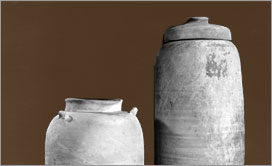
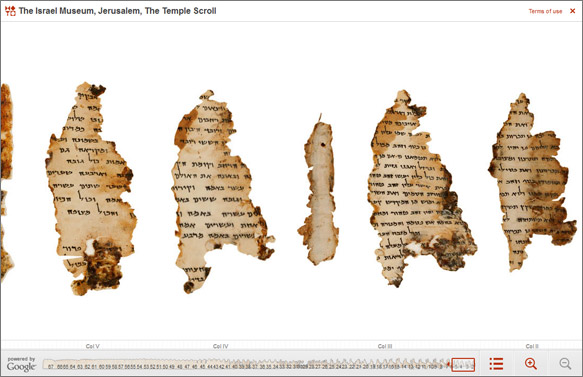
It's a bit of a tongue twister. but the Dead Sea Scrolls have been digitized and are now available online - http://dss.collections.imj.org.il/ as part of the Israel Museum.

The website records the initial discovery of the scrolls:

"The first seven Dead Sea Scrolls were discovered by chance in 1947 by Bedouin of the Ta'amra tribe, in a cave (later given the name "Cave 1") near Khirbet Qumran on the northwest shore of the Dead Sea. Three of the scrolls were immediately purchased by archaeologist Eliezer Lipa Sukenik on behalf of the Hebrew University; the others were bought by the Metropolitan of the Syrian Orthodox Church in Jerusalem, Mar Athanasius Samuel. In 1948 Samuel smuggled the four scrolls in his possession to the United States; it was only in 1954 that Sukenik's son, Yigael Yadin, also an archaeologist, was able to return them to Israel, and they were ultimately entrusted to the Shrine of the Book Foundation. They have been on display in the Shrine of the Book at The Israel Museum, Jerusalem, since 1965.
Over the next few years, from 1949 to 1956, additional fragments of some 950 different scrolls were discovered in ten nearby caves, both by Bedouins and by a joint archaeological expedition of the École Biblique et Archéologique Française and the Rockefeller Museum, under the direction of Professor Father Roland de Vaux. The richest yield, from Cave 4, just opposite the site of Qumran, consisted of some 15,000 fragments. The last cave, Cave 11, was discovered in 1956, and the scrolls found there were in a reasonable state of preservation. Since then, only a few small scraps of parchment have been found in the Judean Desert (though not in the close vicinity of Qumran)."


As the Official Google Blog explains, the digitization allows you to click on the Hebrew text and see an English translation (see below) and that:
"The scroll text is also discoverable via web search. If you search for phrases from the scrolls, a link to that text within the scroll viewers on the Dead Sea Scrolls collections site may surface in your search results. For example, search for [Dead Sea Scrolls "In the day of thy planting thou didst make it to grow"], and you may see a link to Chapter 17:Verse 11 within the Great Isaiah Scroll."


19 Sept 2011

British Library ebook treasures

The British Library has digitized and made available for ipad various handwritten notebooks from their collection - William Blake, Lewis Carroll, Leonardo da Vinci, Jane Austen and Gerardus Mercator .
http://www.ebooktreasures.org/category/books-by-institution/british-library/

For a limited time Alice's Adventures Underground - Lewis Carroll's notebook is available free!


Sample of page from Blake's notebook


From the BL website: "This small notebook, which came into Blake’s possession in 1787 following his brother’s death, was used by Blake for over thirty years to record sketches and to work on drafts of his poems. The dense, closely-filled pages provide a fascinating insight into Blake’s compositional process, and allow us to follow, line by line, correction by correction, the genesis of some of his best-known work, including poems such as ‘London’ and ‘The Tyger' This eBookTreasures version contains the complete manuscript along with commentary on selected pages."


Sample Page from Lewis Carroll's notebook

From the BL website:
"Later known as Alice in Wonderland, this is the original manuscript given by Lewis Carroll to Alice Liddell for Christmas 1864. One summer’s day in 1862, he took Alice and her sisters on a boat trip on the Thames by Oxford, where he taught as a mathematician. Along the way he entertained them with a fabulous story of Alice’s adventures in a magical world entered through a rabbit hole. Ten year-old Alice begged him to write it down, and eventually he did, giving her this meticulous manuscript of the tale for Christmas.

This eBookTreasures version has transcription throughout as well as superb narration by Miriam Margoyles."


30 Aug 2011

Reel British History: new archive facilities at the BFI

The British Film Institute have recently completed a new Master Film Store at a cost of £12m, built to house more than 45,000 cans of British film and preserve a national cinematic legacy. The facility in Warwickshire employs state of the art technology to ensure the longevity of its fragile treasures. Old film stock is notoriously difficult to store safely, likely to disintegrate entirely under the wrong conditions or combust due the highly flammable nature of the nitrate stock of much early film. The expansive new facilities of the Master Film Store offer a safer environment for these fragile materials.

The new facility presents an alternative to archival digitization projects, which, whilst helping to retain the content of older materials on the point of deterioration, is both an expensive and time consuming process, limiting the selection of films to be restored. As an alternative to the long-practiced approach of format conversion, the new facility presents a more cost-effective method, allowing the original material to be accessed safely.

The preservation project seeks to protect national film heritage in the manner of other decorative arts, raising awareness of Britain’s role in the development of global film culture and forming part of a £25m strategy for Screen Heritage UK (SHUK). The strategy represents the largest award ever given to an archival project. SHUK will allow people to search online catalogues of national and regional archives and access a number of films online. The project will launch early next month; further details of the SHUK strategy can be found here.

An interesting little film of BFI Head of Collections and Information, Ruth Kelly, showing BBC News around the old starage facility can also be found here. Kelly shows the old and new facilities, and offers examples of deteriorated film and the problems faced in storage and control.

23 Aug 2011

The ‘Edible’ Archive

The Scottish Council on Archives (SCA) have launched a new archive project for 2011 seeking to compile a wide ranging history of Scottish recipes. As part of the National Archives Awareness Campaign, the SCA has been inviting both archives and the general public to contribute recipes to the project drawn from a variety of sources, including family history, personal recipe books, letters and archival documents. The project includes plans to host a feast in Edinburgh bringing many of the collected recipes to life in cooked dishes.

A full article on the archive and some of its bizarre (and frankly extremely off-putting sounding) entries can be found here News.scotsman.com. The archivists spearheading the project make the point that it’s not so much the recipes they’ve searched for as the stories these recipes tell—one such illuminating example is a rice pudding recipe written in code in a letter from a Scottish soldier in India in 1808. The recipe is used as a practice exercise for his encryption skills. Not exactly poetry, but interesting nonetheless! Plus,Link who doesn’t like rice pudding.

The SCA website can be found here, with an awareness campaign for the Edible collection.

I’ll end with a ‘delicious’ sounding example from the collection for the baking of Locust Bread, taken from the archive of Mount Stuart in Bute, which was brought back to the island by the 4th Marquess of Bute following a trip to Tangiers…get baking.

KHUBZ EL JARADE
Locust Bread

The best way to catch locusts is to repair to the nearest wall, the higher the better. Here, if the season be propitious, numbers of these insects will be found flying with such force against the wall that many will fall senseless to the ground.

Of those that fall, pick up the females - they are somewhat larger and rather lighter in colour. Pull off the head as the head is pulled off a shrimp. Then squeeze the body and there will exude the eggs, like dark and diminutive caviare, to the amount of nearly a teaspoonful from each animal. When half a kilo of this spawn has been obtained in a small basin, mix with half a kilo of flour and bake into small loaves.

Be careful not to let an opportunity pass to make this dish, as these little beasts make their visitation to the North of Morocco, at least, every nine years only. The last swarm occurred in Tangier in AD 1947.

14 Aug 2011

Digital Humanities spotlight: 7 important digitization projects

The 7 projects can be read about here, the one that stood out particularly was the following:


"Long before there was Facebook, Twitter or LinkedIn, there was the Republic of Letters — a vast and intricate network of intellectuals, linking the finest “philosophes” of the Enlightenment across national borders and language barriers. This self-defined community of writers, scholars, philosophers and other thinkers included greats like Voltaire, Leibniz, Rousseau, Linnaeus, Franklin, Newton, Diderot and many others we’ve come to see as linchpins of cultural history. Mapping the Republic of Letters, which we first looked at last year, is a fascinating project by a team of students and professors at Stanford, visualizing the famous intellectual correspondence of the Enlightenment, how they traveled, and how the network evolved over time, bridging humanitarian scholarship and computer science."


10 Aug 2011

Missing papers from National Archives

Recent reports have brought to light the troubling loss of important documents and papers from the National Archive. The Archive lists some 1,600 folders of documents reported missing since 2005, including items such as letters from Sir Winston Churchill to General Franco, minutes of Harold Wilson's meetings with the Queen, and documents from the courts of Henry VIII, Elizabeth I and Charles I. Some files have not been seen since the early 1990s and fewer than half have been recovered.

Despite negative commentary from scholars and historians on the handling of these materials (outlined in greater detail in this Telegraph online article), an archives spokesman said missing files amounted to 0.01 per cent of the collection. There is also an ongoing programme in place to search for lost items.

Many missing items relate to key moments in British history. Here’s hoping it’s an unfortunate but temporary misplacement...